 Mariposas
Mariposas vs DigiBuddy
 By Zachary, builder of Mariposas
· Last updated June 2026
By Zachary, builder of Mariposas
· Last updated June 2026
DigiBuddy is a virtual pet that you care for through your daily steps and exercise. It’s a fun pet app. The real difference is what you’re rewarded for: DigiBuddy grows its pet from steps & activity, while Mariposas rewards real logged workouts, strength training (sets and reps), GPS runs, and studio classes, with collectible watercolor pets, outfits, streaks and friends.
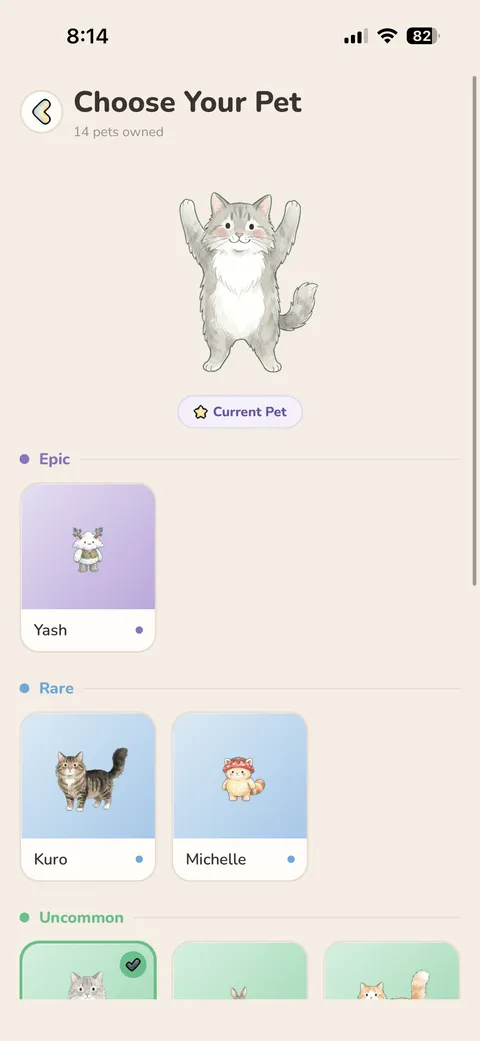
Track lifts, runs & classes and collect a pet for every session, free on iOS.
Download free on iOS| Mariposas | DigiBuddy | |
|---|---|---|
| Rewards you for | Real workouts, lifts, runs & classes | Steps & activity |
| Tracks actual workouts | ✅ Sets/reps, GPS runs, class calories | - |
| Pets & outfits | ✅ Collectible watercolor pets + outfits | ✅ Care for a pet via activity |
| Price | Free | Free |
The honest take
Where DigiBuddy stands out: a pet that reacts to your real-world activity, custom step and exercise targets, automatic apple watch sync. Your activity feeds the pet, but it does not log actual workouts, no set/rep tracking, GPS runs or class calories. It is a companion, not a tracker.
Pick DigiBuddy if you want a charming activity companion that reacts to your day rather than a workout log.
Pick Mariposas if consistency is your real obstacle, a pet for every workout, streaks and friends are built to make showing up stick.
Full disclosure: this comparison is published by the maker of Mariposas; we keep DigiBuddy’s strengths honest so it stays genuinely useful.
What DigiBuddy Actually Does Well
DigiBuddy nails something most fitness apps completely ignore: the emotional side of showing up. Your virtual pet reacts visibly to how active you've been. Skip a few days and it looks listless. Hit your step goal and it perks up, plays around, maybe unlocks a new accessory or animation. That feedback loop is genuinely clever. It taps into the same psychological wiring that made Tamagotchis addictive in the nineties, except now your real-world movement is the input.
The Apple Watch sync is seamless. Steps and general activity flow in automatically without you touching the app, which keeps the barrier to engagement low. You can also set custom step and exercise targets rather than being locked into a generic 10,000-step default, which matters if you're recovering from an injury or if you're a high-volume athlete for whom 10k steps before noon is a rounding error.
The social layer deserves credit too. Seeing a friend's pet thriving when yours looks sluggish is a surprisingly effective nudge. It avoids the chest-thumping leaderboard format that burns people out and replaces it with something lower-stakes and more playful. For people who find traditional fitness apps stressful or clinical, that tonal difference is real and meaningful.
Where the Two Apps Part Ways
DigiBuddy tracks that you moved. Mariposas tracks what you did and how hard you did it. That distinction determines almost everything about which one belongs on your home screen.
If you ran four miles this morning, DigiBuddy knows you were active. Mariposas logs the GPS route, pace splits, and estimated calories burned for that specific run. If you did five sets of Romanian deadlifts, DigiBuddy sees elevated activity; Mariposas records the exercise, weight, and reps so you can look back in three months and see concrete progress. The same goes for fitness classes: Mariposas can log a spin session with class calories, whereas DigiBuddy absorbs it as general movement data.
This is not a knock on DigiBuddy. It was built to be a companion, not a performance log, and it succeeds on those terms. But if you want to answer the question 'am I actually getting stronger or faster over time,' you need the kind of structured workout history that DigiBuddy was never designed to provide.
Mariposas also leans into collectible motivation: pets, streaks tied to logged workouts, and friends who can see your real training activity. The gamification here is anchored to specific sessions rather than to ambient daily movement, which rewards intentional training rather than just a busy day on your feet.
Choosing the Right Tool for How You Actually Train
DigiBuddy is a strong fit if your primary goal is building a daily movement habit from scratch, staying consistent on rest days, or adding a lighthearted social dimension to an otherwise solitary routine. It works especially well alongside a structured program because it keeps you mindful of activity on the days you are not formally training.
Mariposas fits people who are already logging workouts or want to start, and who need a record they can actually analyze. Runners who care about their pace over time, lifters who need to track progressive overload, and anyone juggling multiple types of training across a week will find Mariposas gives them data DigiBuddy simply does not capture.
The honest answer for plenty of people is that both apps can coexist. DigiBuddy handles the ambient motivation and step awareness; Mariposas handles the actual training log. They are solving adjacent problems, not the same one.
FAQ
- Can I use DigiBuddy and Mariposas at the same time?
- Yes, and for many people that combination makes practical sense. DigiBuddy runs in the background responding to your general daily movement, while Mariposas serves as the structured log for specific workouts like lifts, runs, or classes. They pull from different data and serve different purposes, so they do not conflict.
- Does Mariposas track steps the way DigiBuddy does?
- Mariposas is focused on logged workout sessions rather than passive step counting. If step tracking and ambient activity monitoring are central to what you want, DigiBuddy handles that more naturally. Mariposas is built around intentional training: sets, reps, GPS routes, class sessions, and the progress you make in those over time.
- I am mostly a casual walker. Is Mariposas overkill for me?
- Possibly. If walking is your main form of exercise and you are not tracking structured workouts, DigiBuddy is likely a better match for your current routine. Mariposas earns its place when you have specific training to log and want to see how it accumulates week over week. That said, Mariposas works fine for logging casual runs or simple bodyweight sessions too, so it depends on how much detail you actually want.
- Does DigiBuddy replace a fitness tracker app entirely?
- Not quite. It replaces the motivational layer of a fitness app and does that job charmingly, but it does not replace the logging and analysis functions. If you have ever wanted to look up what weight you used on an exercise six weeks ago, or compare your mile pace from month to month, DigiBuddy does not store that kind of information. That is the gap a dedicated tracker like Mariposas fills.