 Mariposas
Mariposas vs Wokamon
 By Zachary, builder of Mariposas
· Last updated June 2026
By Zachary, builder of Mariposas
· Last updated June 2026
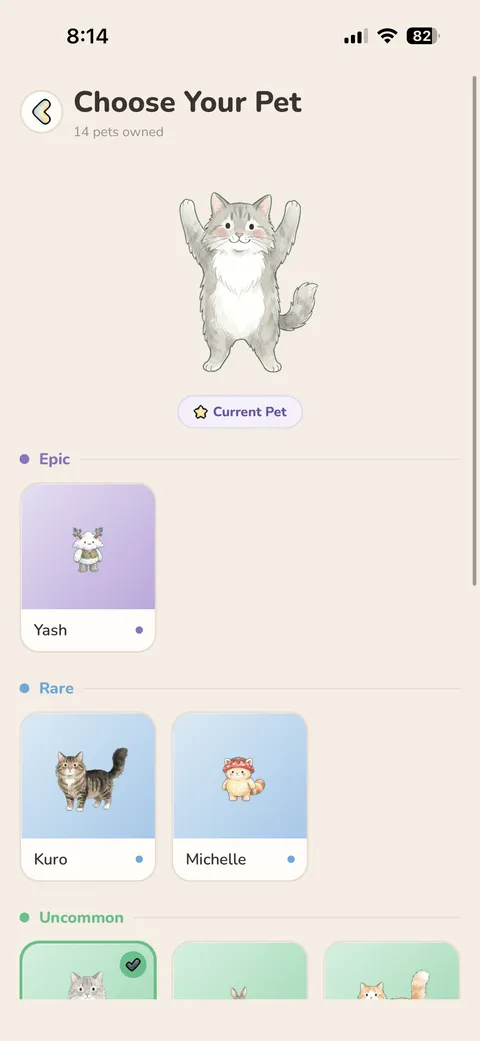
Wokamon is a cute pedometer game where your steps grow and hatch little monster pets. It’s a fun pet app. The real difference is what you’re rewarded for: Wokamon grows its pet from steps (pedometer), while Mariposas rewards real logged workouts, strength training (sets and reps), GPS runs, and studio classes, with collectible watercolor pets, outfits, streaks and friends.
Track lifts, runs & classes and collect a pet for every session, free on iOS.
Download free on iOS| Mariposas | Wokamon | |
|---|---|---|
| Rewards you for | Real workouts, lifts, runs & classes | Steps (pedometer) |
| Tracks actual workouts | ✅ Sets/reps, GPS runs, class calories | - |
| Pets & outfits | ✅ Collectible watercolor pets + outfits | ✅ Grow monsters from steps |
| Price | Free | Free with in-app purchases |
The honest take
Where Wokamon stands out: turning daily steps into pet growth, simple, charming pedometer game, syncing with health and fitbit. It is step-based, it rewards walking, not logged strength workouts, runs or classes, so there is no real training tracker underneath the pet.
Pick Wokamon if you mainly want a fun pedometer that turns daily steps into a growing pet.
Pick Mariposas if consistency is your real obstacle, a pet for every workout, streaks and friends are built to make showing up stick.
Full disclosure: this comparison is published by the maker of Mariposas; we keep Wokamon’s strengths honest so it stays genuinely useful.
What Wokamon Does Really Well
Wokamon nails something genuinely hard: making the act of walking feel rewarding on days when you have zero motivation to exercise. The app converts raw step count into food your little monsters eat, and watching them grow from a blob into a fully animated creature is a surprisingly effective nudge to take the stairs or park further away. The visual feedback loop is immediate and low-pressure, which is exactly right for that use case.
The Health and Fitbit integration is clean. You open the app, your steps are already there, and your monster has already eaten. There is no manual logging, no friction, no setup ritual. For someone who wants a passive, always-on pedometer with a game layer on top, that simplicity is a real feature, not a shortcut.
The monster collection mechanic also gives Wokamon a genuine long-term hook. Different creatures unlock at different milestones, so there is always something ahead worth walking toward. That kind of collectible progression works well for people who respond to completion and discovery rather than raw performance numbers.
Where the Two Apps Actually Differ
The core difference is what counts. Wokamon measures steps. Full stop. A 45-minute barbell session, a 5K run tracked by GPS, a spin class, a swim: none of those feed your monster unless they happened to generate steps on your phone or watch. That is not a flaw in Wokamon's design, it just reflects what the app is built for. If your fitness life consists of things other than walking, the pet growth stops representing your effort.
Mariposas works the other way around. The butterfly grows when you log actual training: strength sessions with sets and reps, runs with pace and distance, classes, whatever your real workouts look like. The motivation layer (the butterfly, streaks, a friend system built around shared progress) sits on top of a genuine training log, not a pedometer. That means the creature in Mariposas reflects the full picture of your training week, not just how many steps you happened to accumulate.
There is also a social dimension worth separating out. Wokamon has some friend features, but they are oriented around step comparisons. Mariposas is built around friends seeing your logged workouts and your butterfly's growth together, which tends to create accountability for the training itself rather than just daily movement.
Picking the Right App for How You Actually Train
Wokamon is a genuinely good choice if your main goal is increasing daily movement and you want something that runs completely in the background with no manual input. It fits people who are building a walking habit, those doing a step-challenge at work, or anyone who just wants a fun reason to move more without thinking about it. The charm is real and the simplicity is a feature.
Mariposas fits better when your training has more structure: you lift on specific days, you follow a running plan, you take classes, you want your log to actually mean something over weeks and months. The pet mechanic in Mariposas serves the same emotional function as Wokamon's monsters, making progress feel alive rather than abstract, but the data underneath it is a real workout record rather than a step count.
Some people use both. Wokamon runs passively and handles daily movement. Mariposas handles the intentional training sessions. They do not really overlap.
FAQ
- Can I use Wokamon and Mariposas at the same time?
- Yes, and for a lot of people that combination makes sense. Wokamon runs in the background tracking your steps and feeding your monsters automatically. Mariposas requires you to log workouts, so it handles the intentional training side: your lifts, runs, and classes. The two apps pull from different data and serve different habits, so they do not conflict.
- Does Wokamon track strength training or running?
- Not directly. Wokamon tracks steps, so a run will register if it generates steps on your device, but there is no way to log sets, reps, pace, or class type. A heavy lifting session in a squat rack produces almost no steps and would not feed your monster at all. If tracking those workouts matters to you, Wokamon is not designed for that.
- Is Mariposas only for serious athletes?
- No. The app is built around logging whatever workouts you actually do, from a 20-minute home session to a full strength program. The butterfly grows based on consistency with your own training, not on hitting any particular performance threshold. People at all experience levels use it; the common thread is wanting a log that goes deeper than step count.
- Does Wokamon require a fitness tracker to work?
- No. Wokamon can use your phone's built-in step counter through Apple Health or Google Fit, so a dedicated tracker is not required. It also syncs with Fitbit if you have one. The setup is minimal either way.